What Changes When Your Group Hits 20+ People
The rules of Secret Santa don't change at scale — the logistics do. With 20, 30, or 50 participants, the anonymity feels more genuine (you might genuinely not know who drew your name), wishlists become necessary rather than optional (Santa can't rely on personal knowledge), and the reveal is more dramatic.
But three things that work fine in a group of 10 break down fast at 30+: manual name draws (too many ways to go wrong), exclusion management (the constraint space shrinks as the group grows), and address collection for virtual exchanges (email threads become a management project).
The challenges are all logistical, and every one has a clean solution. This guide covers budget-setting, exclusions, digital draws, dropout handling, and the timeline you need to not be scrambling the week before your party.
Setting the Budget for Large Groups
Budget decisions get harder as groups get larger, because larger groups tend to be more economically diverse. A $50 Secret Santa that's comfortable for a senior manager might be a genuine financial burden for an entry-level employee on the same team.
The rule for large groups: the more people, the lower the target budget. Here's what works at different scales:
Small office (10–20 people): $20–$30 is the standard. Enough to buy something thoughtful, low enough to feel approachable for everyone.
Mid-size group (20–40 people): $15–$25. At this size, income diversity increases and the event should remain voluntary. Set $20 as a firm number, not a range — ranges create comparison anxiety.
Large group (40+ people): $10–$20. Lean into themes (foodie, self-care, desk upgrade) that make a $15 gift feel intentional rather than token.
Set a single fixed number, never a range. "Spend up to $25" sounds flexible but results in a mix of $10 and $50 gifts that make the reveal awkward.
Managing Exclusions at Scale
Exclusions — rules preventing certain people from being assigned to each other — get complicated fast in large groups. In a family exchange, you might want: spouses excluded from each other, parents excluded from their children, and siblings excluded from each other. Add a group of 30 people with complex relationships and the constraint space shrinks dramatically.
Elfster handles exclusions algorithmically, so it will flag when your exclusion list makes a valid draw impossible. The practical guidance:
Keep exclusions minimal. In a 30-person exchange, excluding every married couple leaves a manageable space. Excluding every sibling pair plus every past-relationship pair in a close friend group of 20 might make a valid draw mathematically impossible.
Prioritize spouse exclusions and direct family exclusions. These matter most — nobody wants to be assigned their own partner in a supposedly anonymous exchange.
For complex family trees, consider splitting into smaller groups: adults in one exchange, kids in another, extended family in a third. Three clean exchanges of 10 are easier to run than one messy exchange of 30.
The Draw: Why Digital Is Non-Negotiable at 20+ People
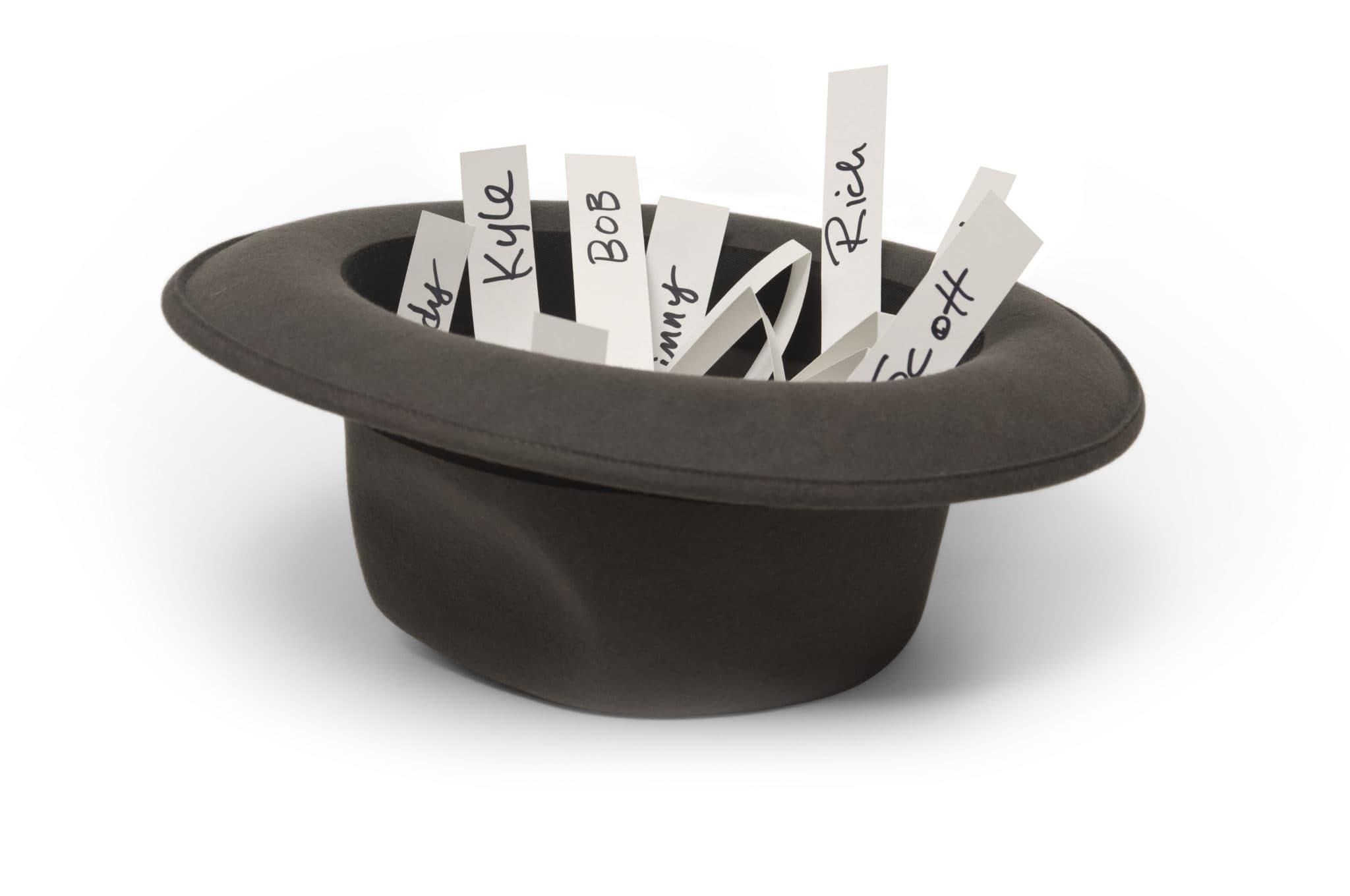
Physical name draws — slips of paper in a hat — have a hard failure mode at scale. Someone draws their own name. Two people swap slips to avoid getting someone they don't like. The organizer sees every slip. An exclusion rule gets accidentally violated.
At 20+ people, use a digital draw. Elfster's algorithm: - Guarantees no one draws their own name - Respects all exclusion pairs you've set - Notifies each participant privately by email (the draw is private by default — organizer can optionally view assignments) - Sends automatic reminders to participants who haven't accepted - Handles re-draws in seconds if someone drops out
Setup takes five minutes. Participant invitations go out the moment you draw — no manual follow-up required until someone hasn't accepted their invitation.
Managing Address Collection for Remote Participants
For remote teams, long-distance families, or any group that isn't gathering in person, address collection is the operational bottleneck that derails most organizers.
The typical approach — "everyone email me your address" — produces a chaotic inbox, a manually built spreadsheet, and at least two people who forget to send it. For 30+ people, it's a genuine project.
Elfster collects shipping addresses as part of participant sign-up. When your match is assigned, Elfster shares only their address with you — not their email, not their phone, nothing else. The organizer never needs to build or share a master address list. Participants control what contact information is visible.
For very large groups, add a deadline for address submission to the invitation: "Add your address to Elfster by December 1 so your Santa has time to ship." Late address submissions are the most common cause of gifts arriving after the reveal date.
Organizers can also send private messages to participants directly through Elfster for any coordination that needs to happen outside the automatic notifications — without sharing personal contact information.
Handling the Inevitable Dropout
In any group over 15 people, someone will drop out after the draw. It's not a plan failure — it's a statistical certainty. Have a contingency before it happens.
What happens when someone drops out: two people are affected. The person who was assigned as their giver now has no recipient. The person they were supposed to give to now has no giver. The cleanest fix is a re-draw in Elfster, which takes seconds and re-notifies everyone automatically.
If a re-draw isn't possible (gifts are already bought and wrapped), manually pair the two affected participants with each other. They each receive something and each give something — the cycle is preserved.
For very large groups where one dropout feels minor: consider designating a backup participant who joins the draw but is prepared to absorb a dropout gracefully. They can re-gift or donate what they already bought.
The one thing to avoid: ignoring the dropout and hoping nobody notices. Someone notices.
Creative Formats for Large Groups
Standard Secret Santa works fine at any size, but large groups sometimes benefit from a format variation that adds structure:
Tiered budget draws — For groups with clear seniority levels (all-company holiday exchange), tier the budget by level rather than setting one number. Senior leadership draws from a higher-budget pool. Entry-level employees draw from a lower one. Gift-giving reflects the group's reality rather than pretending it doesn't exist.
Department brackets — Divide a large organization into smaller sub-exchanges of 8–12 people, each within a department or team. Each group runs its own Secret Santa. Better for meaningful gift-giving because people actually know each other.
Theme-based large exchange — Add a theme (foodie, desk upgrade, book swap) to constrain a large anonymous exchange toward a range where the budget constraint feels creative rather than limiting. Themes are especially helpful when participants don't know each other well.
White Elephant variation — For very large groups (50+) where buying for one specific unknown person feels too random, switch to White Elephant. Everyone brings a gift to the communal pool. There's no assignment at all.
Timeline for a Large Group Exchange
The bigger the group, the more lead time you need. A 10-person family exchange can be organized in a week. A 40-person office exchange needs six weeks minimum.
Six weeks out: Create the Elfster exchange and send invitations. Include the date, budget, theme (if any), and RSVP deadline.
Four weeks out: Chase non-responses. At this point, close the participant list and run the draw. Waiting longer risks the gift-buying window collapsing.
Three weeks out: Everyone should know their match and have access to wishlists. This is when buying happens.
One week out: For virtual exchanges, gifts should already be shipped. Send a reminder about the reveal date and video call link.
Day of: Reveal. Follow up with a group thank-you message and a note about next year.
The single most common organizer mistake: running the draw too late. When the draw happens two weeks before the party, participants have almost no time to buy, ship, and wrap — and the organizer fields frantic messages the whole way through.
Ready to Draw Names for Your Group?
2026 Update: Trending Themes Worth Trying This Year
Frequently Asked Questions
How many people is considered a large Secret Santa group?
Most organizers start feeling the logistics strain around 20+ participants. At 30+, manual coordination becomes impractical — digital tools like Elfster become essential for managing invites, draws, exclusions, and wishlists at that scale.
Does Secret Santa work with an odd number of people?
Yes — Secret Santa creates a directed gift cycle, not pairs, so it works perfectly with any number of participants, odd or even. Elfster handles the math automatically.
What's the best budget for a large group Secret Santa?
The more diverse the group, the lower the budget should be. For mixed-income large groups, $20–$25 is the most inclusive range. Set a single number (not a range) so all gifts are comparable.
How do I collect addresses for a large virtual Secret Santa?
Elfster collects shipping addresses privately from each participant as part of sign-up — givers see their match's address but no other personal details. No spreadsheet required.
What if someone drops out of a large group Secret Santa after the draw?
When one person drops out, two people are affected: the person who had them as a match, and the person they were assigned to give to. The cleanest fix is a re-draw via Elfster, which takes seconds.